The PASS Training Marketplace
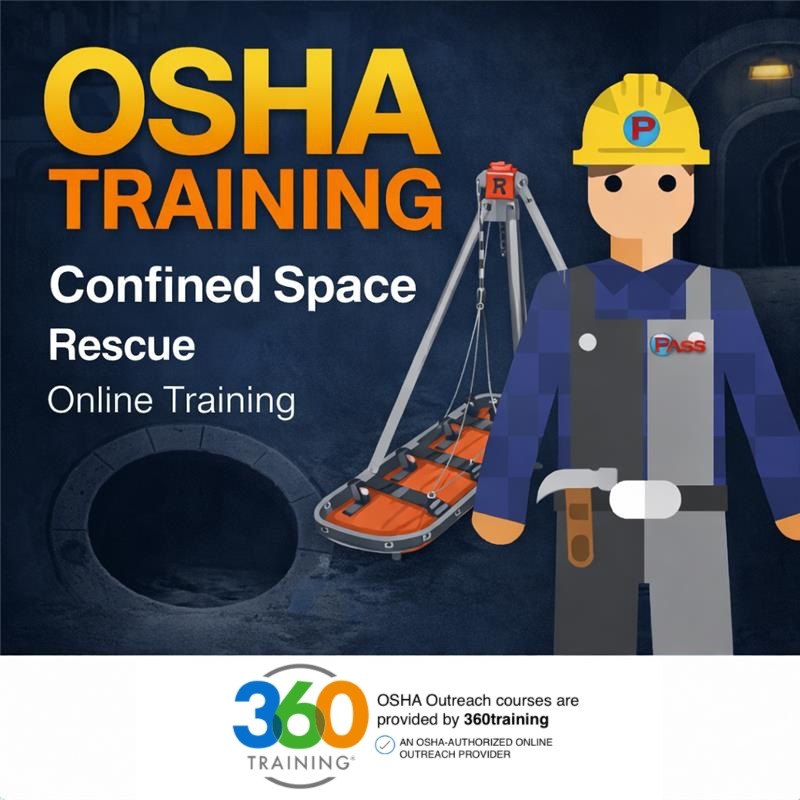
Confined Space Rescue Online Training
Product Description
Confined Space Rescue Online Training
Provided by 360Training
This Confined Space Rescue Online Training course, provided by 360Training and offered through PASS Training & Compliance, equips workers and employers with critical knowledge needed to prepare for and respond to confined space emergencies. Proper rescue planning is essential, as confined space incidents can escalate quickly and pose life-threatening hazards.
This OSHA-aligned course covers confined space classification, hazard recognition, atmospheric testing, and emergency response planning. Participants will learn the fundamentals of rescue procedures, including non-entry rescue techniques, use of retrieval systems and tripods, ventilation equipment, personal protective equipment (PPE), respiratory protection considerations, and safe operational protocols. The training also reinforces the importance of permit programs, signage, barricades, and clearly defined rescue roles and responsibilities.
Aligned with applicable OSHA standards including 29 CFR 1910.146, 29 CFR 1910.134, 29 CFR 1926 Subpart AA, and 29 CFR 1915 Subpart B, this course supports regulatory compliance across general industry, construction, and shipyard operations.
Delivered in a convenient, self-paced online format, the course includes a final exam to verify comprehension. Upon successful completion, participants receive a certificate of completion. Through the PASS platform, organizations can easily assign, track, and document training to strengthen confined space safety programs and emergency preparedness efforts.
Ideal for workers, supervisors, safety professionals, and rescue team members involved in confined space operations.
Confined Space Training Online
Provided by 360training
Confined Space Training Online, provided by 360training and offered through PASS on their behalf, is designed to help employers and workers reduce the risks associated with confined space operations. Approximately 100 confined space-related fatalities occur each year in U.S. workplaces, underscoring the importance of proper hazard recognition, training, and regulatory compliance. This course delivers foundational safety instruction aligned with applicable OSHA standards for general industry, construction, shipyards, and respiratory protection.
Participants will gain a comprehensive understanding of confined space safety principles, including how to define and differentiate between various types of confined spaces and determine whether a space is permit-required or non-permit. The course explains how to recognize and assess hazardous atmospheres, including oxygen deficiencies, toxic gases, and flammable vapors, and outlines proper atmospheric testing procedures.
Training also covers the proper use and inspection of personal protective equipment (PPE) for confined space entry, as well as the use and maintenance of ventilators, respirators, and air-supplying equipment. Participants will learn how to properly set up and use entry equipment such as tripods, lifelines, ladders, lighting, and fire extinguishers to support safe operations.
In addition, the course addresses the importance of signage, barricades, and implementing a permit program, along with identifying common confined space hazards and reviewing real-world accident scenarios to reinforce preventive measures. Non-entry rescue techniques are also discussed to ensure workers understand emergency response considerations.
This training is aligned with OSHA standard requirements, including:
- OSHA 29 CFR 1910 – General Industry
- 29 CFR 1910.146 – Permit-Required Confined Spaces
- 29 CFR 1910.134 – Respiratory Protection
- OSHA 29 CFR 1926 – Construction Industry
- 29 CFR 1926 Subpart AA – Confined Spaces in Construction
- OSHA 29 CFR 1915 – Shipyards
- 29 CFR 1915 Subpart B – Confined and Enclosed Spaces and Other Dangerous Atmospheres in Shipyard Employment
Through the PASS platform, organizations can assign, manage, and document this training as part of their overall safety and compliance program.
- Final Exam
- Yes
- Final Exam Passing Score
- 80%
- Certificate
- Yes
- Average Rating
- / 0 Reviews
Equipment Chapter 1
This chapter covers the essential equipment used for safe confined space operations. Participants will learn how to properly select, inspect, and maintain tools and entry devices required for confined space work. The training emphasizes the importance of pre-use inspections, equipment functionality checks, and ensuring all devices are appropriate for the sp
PPE (Personal Protective Equipment) Chapter 2
This chapter explains the types of personal protective equipment required when working in or around confined spaces. Learners will review proper selection, inspection, and use of PPE such as respirators, harnesses, lifelines, gloves, eye protection, and protective clothing. The chapter highlights how PPE serves as a critical control measure when engineering and administrative controls cannot fully eliminate hazards.
Testing Chapter 3
In this chapter, participants will learn proper atmospheric testing procedures for confined spaces. Topics include measuring oxygen levels, identifying oxygen-deficient or oxygen-enriched atmospheres, detecting flammable vapors, and monitoring for toxic gases. The importance of continuous monitoring and proper calibration of testing equipment is also discussed to ensure safe entry and ongoing protection.
Operations Chapter 4
This chapter outlines safe work practices and operational procedures for confined space entry. It covers pre-entry planning, hazard assessment, communication protocols, entry supervision, and compliance with permit program requirements. Emphasis is placed on maintaining controlled entry conditions and following established procedures to reduce the risk of injury or fatality.
Hazards Chapter 5
This chapter identifies common confined space hazards, including hazardous atmospheres, engulfment risks, mechanical and electrical hazards, chemical exposure, and limited entry/exit challenges. Participants will learn how to recognize these dangers and apply appropriate preventive measures, including engineering controls, administrative controls, and proper protective equipment.
