The PASS Training Marketplace
Confined Space (Competent Person) Online Training
Product Description
Confined Space (Competent Person) Online Training
Provided by 360training | Offered through PASS
Confined Space (Competent Person) Online Training is an OSHA-aligned course designed to prepare individuals to identify, evaluate, and control hazards associated with confined spaces. Provided by 360training and offered through PASS, this training supports compliance with applicable OSHA standards for general industry, construction, and shipyard employment.
The course covers essential topics including equipment inspection, atmospheric monitoring and testing, safe operating procedures, confined space access protocols, hazard recognition (including IDLH atmospheres), and rescue methods. Participants will review the responsibilities of a Competent Person and the requirements for maintaining a compliant confined space program.
This training aligns with OSHA standards including 29 CFR 1910.146 (Permit-Required Confined Spaces), 29 CFR 1926 Subpart AA (Confined Spaces in Construction), and 29 CFR 1915 Subpart B (Shipyard Employment), among others.
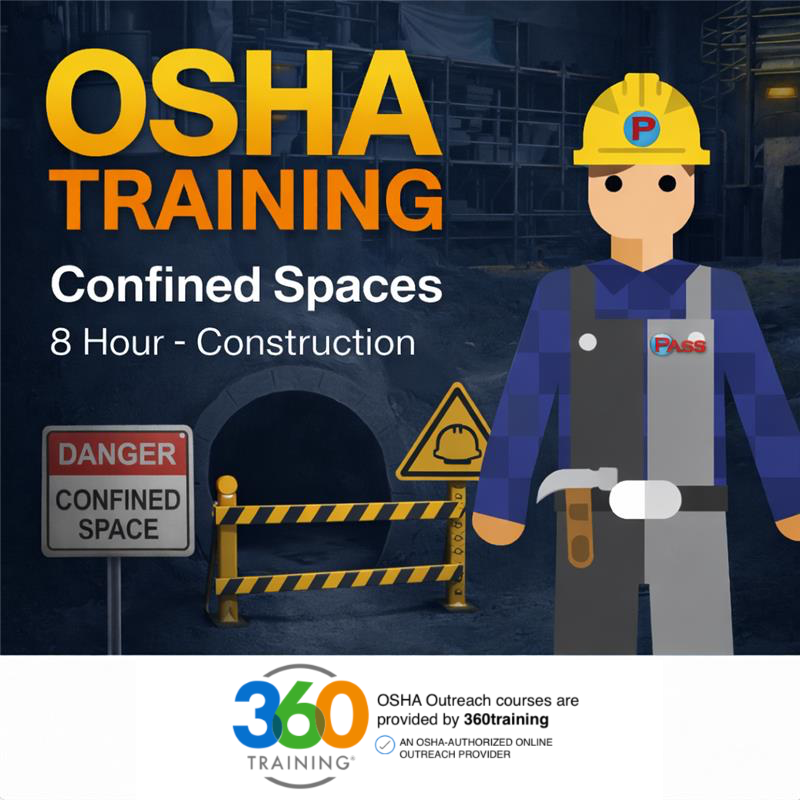
Confined Space Entry Training for Construction (8-Hour)
Provided by 360training
The Confined Space Entry Training for Construction course, provided by 360training and offered through PASS on their behalf, delivers OSHA-aligned instruction designed to meet the requirements of 29 CFR 1926 Subpart AA – Confined Spaces in Construction. This 8-hour training provides construction personnel with the knowledge necessary to safely work in or around confined spaces and to comply with applicable OSHA standards.
The course addresses OSHA safety and health requirements and procedures intended to protect employees exposed to confined space hazards. Participants will learn how to identify permit-required and non-permit confined spaces, apply alternate entry and reclassification procedures, and understand employer program requirements for confined space operations.
Key training topics include:
- The scope and application of OSHA 29 CFR 1926 Subpart AA
- Identification and assessment of confined spaces
- Roles and responsibilities of entrants, attendants, supervisors, and competent persons
- Permit-required confined space program requirements and entry permitting procedures
- Recognition of common confined space hazards
- Atmospheric testing procedures and acceptable entry conditions
- Methods for controlling hazardous energy
- Rescue and emergency service requirements
This course is delivered in an interactive, mobile-friendly online format and includes lesson quizzes and a final exam to verify comprehension. Upon successful completion, participants receive a certificate of completion. Training records can be assigned and managed through the PASS platform to support employer compliance documentation.
- Final Exam
- Yes
- Final Exam Passing Score
- 80%
- Certificate
- Yes
- Average Rating
- / 0 Reviews
Introduction Chapter 1
This chapter provides an overview of confined space hazards in construction and introduces the regulatory framework under OSHA 29 CFR 1926 Subpart AA. Participants will learn key definitions, the purpose of confined space regulations, and the importance of hazard recognition. The lesson establishes foundational knowledge necessary to understand employer requirements and safe entry procedures.
Employer Responsibilities, Communication, and Coordination Chapter 2
This chapter outlines employer obligations for protecting workers who operate in or around confined spaces. Topics include hazard communication, coordination between controlling contractors and entry employers, and information sharing when multiple employers are present on a job site. Emphasis is placed on ensuring clear procedures and accountability to maintain compliance and worker safety.
Program Requirements Chapter 3
This chapter explains the required elements of a permit-required confined space program in construction. Participants will review written program components, hazard evaluation procedures, and documentation requirements. The lesson also addresses how employers must assess work sites to identify and classify confined spaces appropriately.
Permit-Required Confined Space Entry Permitting Chapter 4
This chapter covers the confined space entry permitting process, including how permits are issued, maintained, and canceled. Participants will learn the required information contained on entry permits, how to verify acceptable entry conditions, and the procedures necessary before authorizing entry into a permit-required space.
Roles and Responsibilities Chapter 5
This chapter defines the duties of authorized entrants, attendants, entry supervisors, competent persons, and other designated personnel. Participants will gain an understanding of how each role contributes to maintaining safe entry operations and regulatory compliance, including monitoring, oversight, and hazard response responsibilities.
Training and Employee Participation Chapter 6
This chapter explains OSHA training requirements for workers involved in confined space operations. Participants will learn when training is required, what topics must be covered, and how employee participation strengthens confined space safety programs. The lesson reinforces the importance of competency and ongoing evaluation.
Atmospheric Testing and Ventilation Chapter 7
This chapter focuses on atmospheric hazards commonly found in confined spaces, including oxygen deficiency, toxic gases, and flammable vapors. Participants will review proper atmospheric testing procedures, acceptable entry conditions, continuous monitoring requirements, and ventilation methods used to control hazardous atmospheres.
Controlling Hazardous Energy Chapter 8
This chapter addresses the identification and control of hazardous energy sources that may be present in confined spaces. Topics include lockout/tagout procedures, isolation of mechanical and electrical systems, and safeguarding workers from unexpected energy release during entry operations.
Rescue and Emergency Services Chapter 9
This chapter outlines OSHA requirements for rescue planning and emergency response. Participants will learn the differences between entry and non-entry rescue, the responsibilities of designated rescue personnel, and the need for proper equipment and annual rescue practice. The lesson emphasizes the importance of pre-entry planning to ensure rapid response in emergencies.

